understanding the full picture.
Comprehensive neurodevelopmental and psychoeducational assessments for children, adolescents and young adults aged 5–25.
because difficulties rarely come from one thing.
WHY COMPREHENSIVE?
Attention, learning, behaviour, social relationships and emotional wellbeing can overlap. A comprehensive assessment looks across these areas together so the result is a clearer picture of strengths, needs and what will actually help.
Identify strengths as well as areas of difficulty.
✦
Differentiate between overlapping conditions.
✦
Clarify complex or unclear presentations.
✦
Provide practical recommendations for home, school and other settings.
✦
Assessment may explore
✦
✦
✦
✦
✦
✦
✦
✦
✦
✦
✦
✦
Autism
ADHD
Intellectual Disability
Cognitive abilities
Adaptive Behaviour
Social communication differences
Learning Difficulties
Specific Learning Disorders (SLD)
Dyslexia, Dysgraphia + Dyscalculia
Processing differences
Giftedness + twice-exceptionality
Executive functioning
THE PROCESS
thorough, but clear.
WHICH PACKAGE?
choose the question you’re trying to answer.
These descriptions are a guide; if you are unsure, book the free 15-minute phone call first.
Cognitive Assessment Package
For families wanting to understand a young person’s cognitive strengths and areas of difficulty, with recommendations for how best to support their cognitive development.
A cognitive assessment on its own is not designed to provide enough information to determine a diagnosis.
Typically includes:
Telehealth parent intake interview
Cognitive assessment
Report writing and information integration
Telehealth parent results meeting
Developmental Assessment Package
For assessment of a young person’s development and neurodevelopmental profile without investigating academic skills. This package is suitable to investigate autism, ADHD, intellectual disability - where there are no concerns related to academic abilties.
Typically includes:
Telehealth parent intake interview
Cognitive assessment
Neurodevelopmental assessment
Additional parent telehealth session (if needed)
Report writing and information integration
Telehealth parent results meeting
Educational Assessment Package
This assessment package aims to understand a child’s cognitive and academic strengths and difficulties to help inform supports for learning, at home and in the classroom. This package is best suited when the primary question is a possible Specific Learning Disorder such as dyslexia, dysgraphia or dyscalculia.
Where there are learning difficulties alongside concerns related to development, social relationships, or attention, a Comprehensive Assessment Package may be more appropriate.
Typically includes:
Telehealth parent intake interview
Cognitive assessment
Academic assessment
Report writing and information integration
Telehealth parent results meeting
Comprehensive Assessment Package
A broader assessment designed to develop a more complete picture of development, cognitive abilities, academic skills, mental health and everyday functioning.
Often most useful where concerns overlap across several areas or the presentation is more complex.
Typically includes:
Telehealth parent intake interview
Cognitive assessment
Neurodevelopmental assessment
Academic assessment
Additional parent telehealth session (if needed)
Report writing and information integration
Telehealth parent results meeting
ASSESSMENT PACKAGES
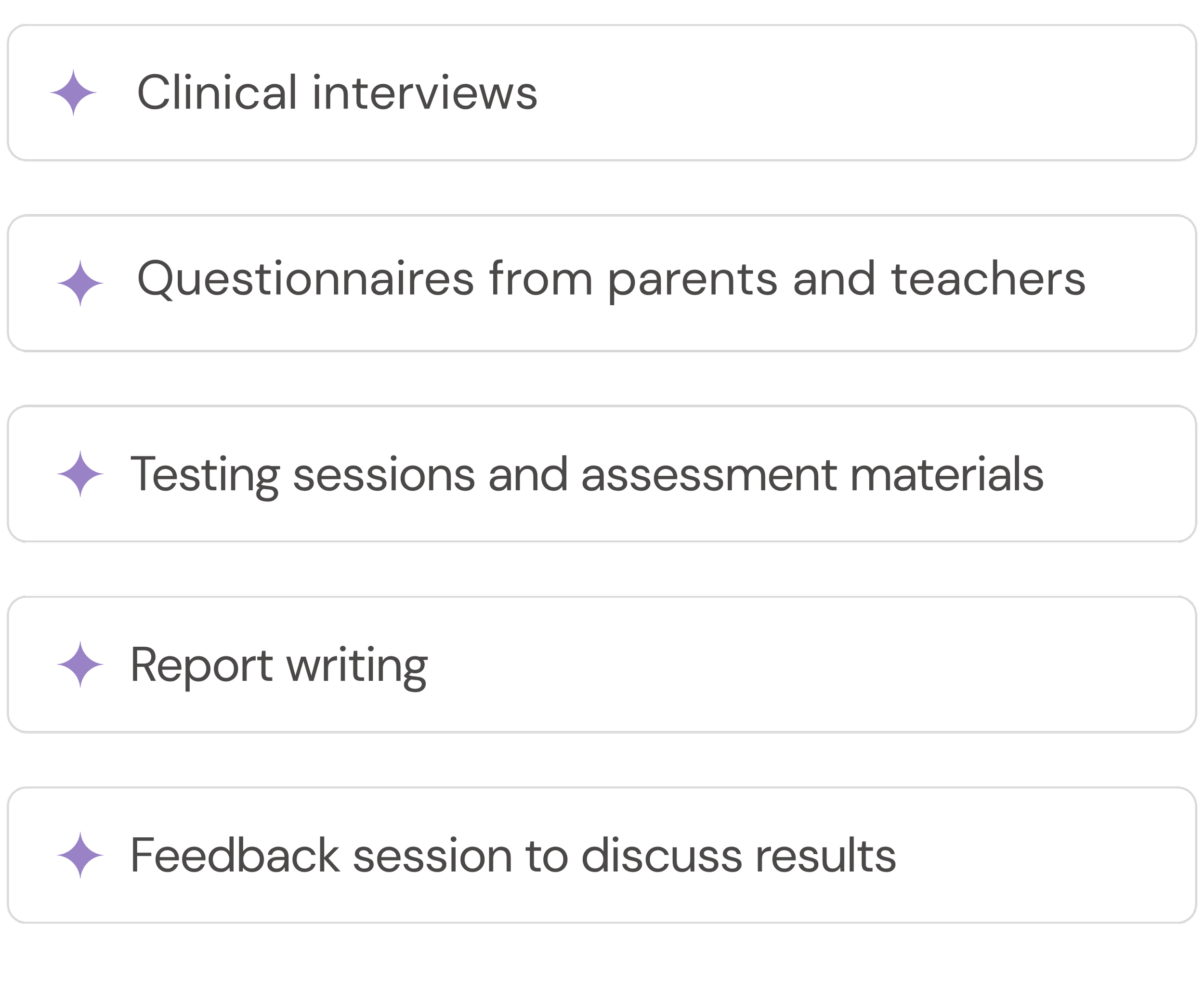
what the assessment process may involve.
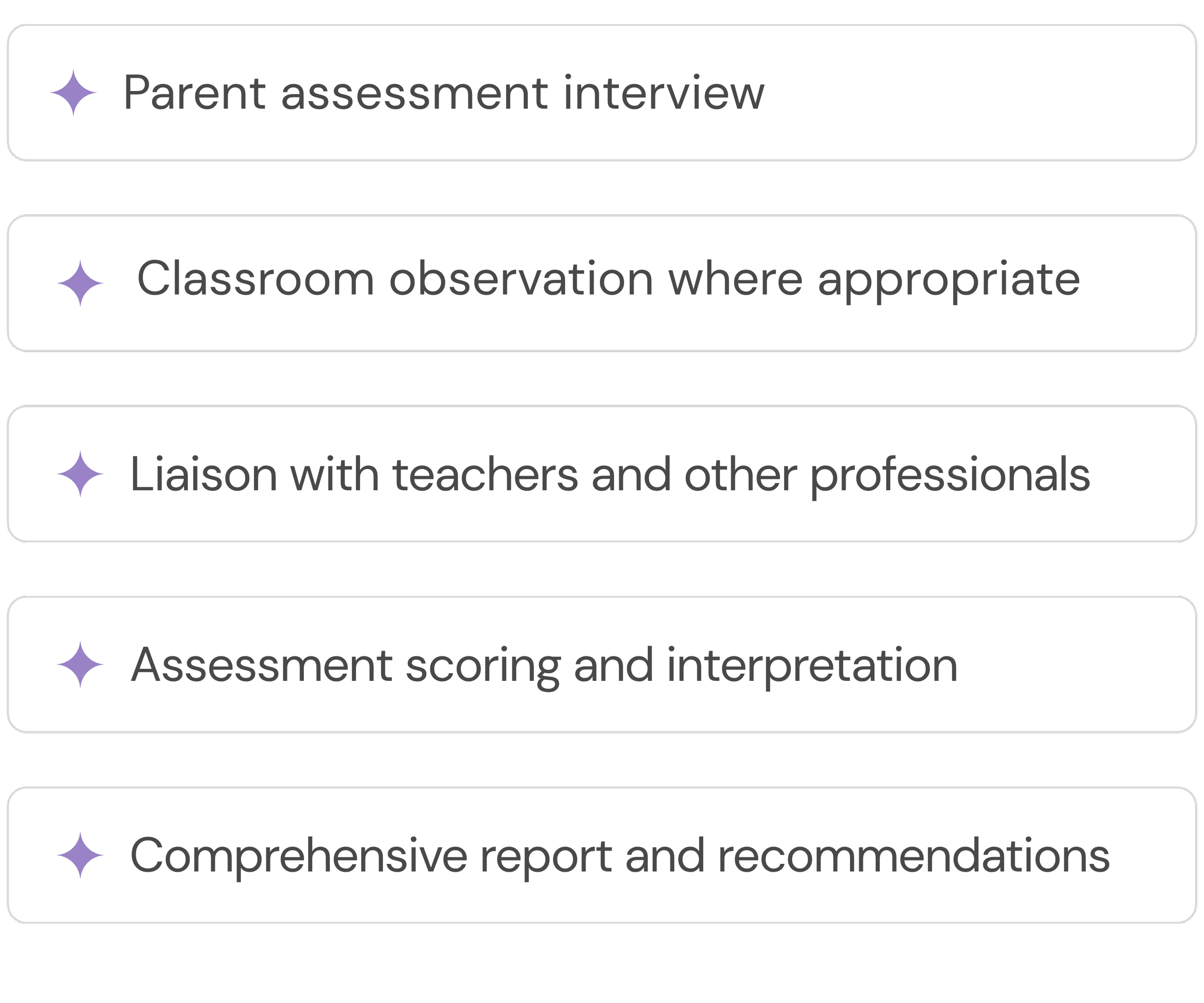
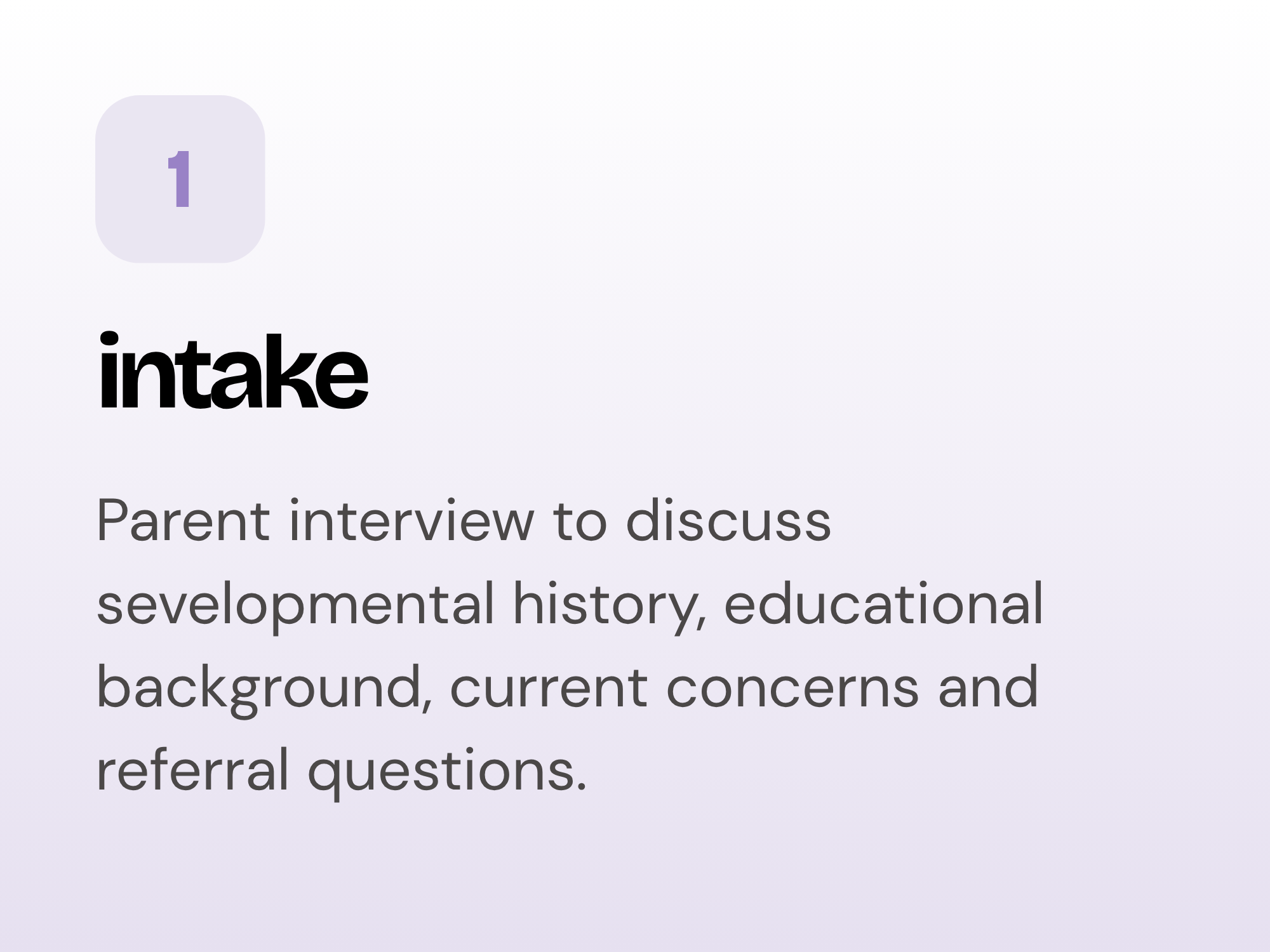
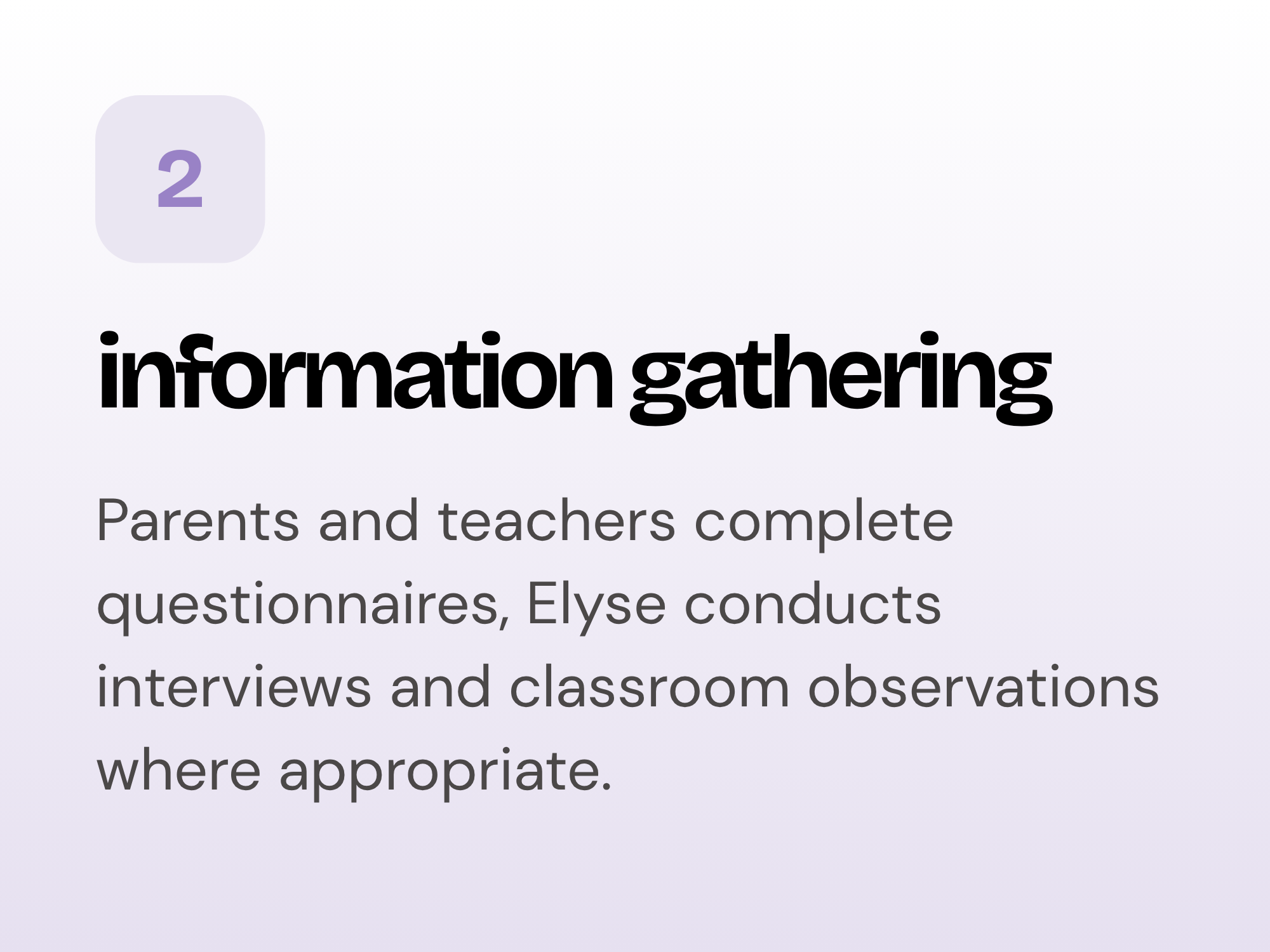
The exact components depend on the package and referral question. The broader assessment process may include: